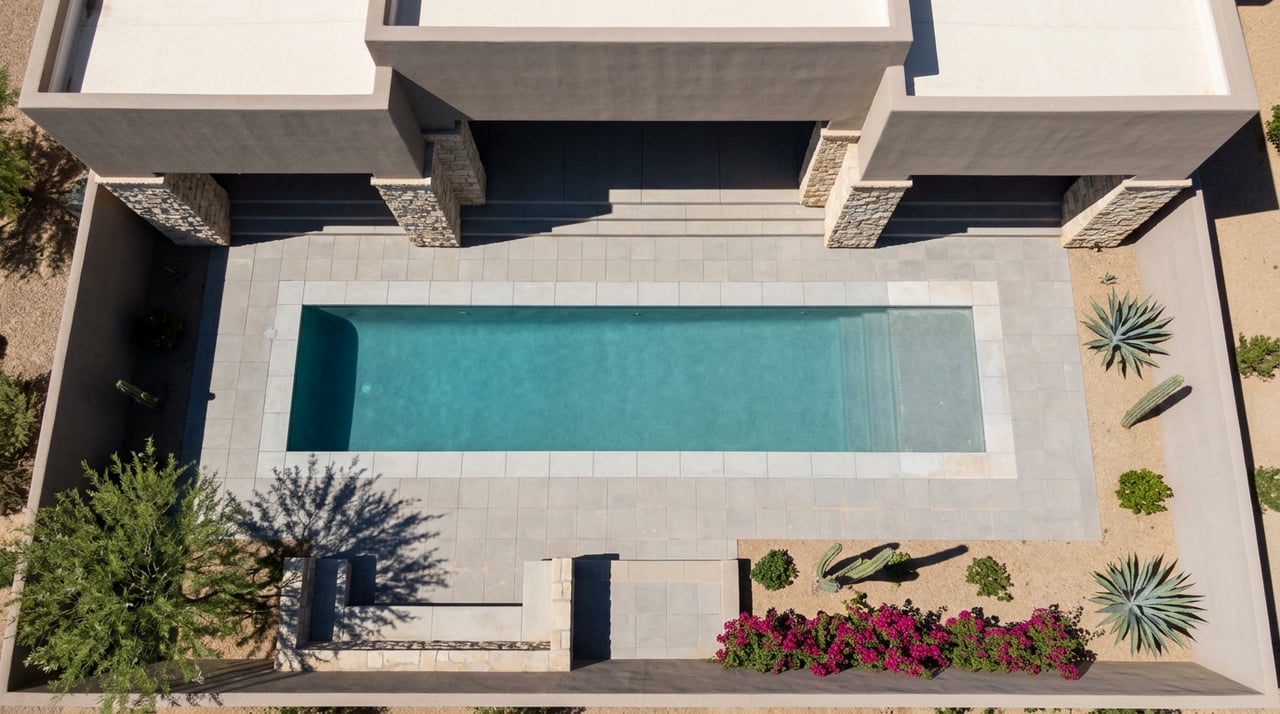
North Phoenix Home Prices by Neighborhood: Why Markets Diverge
September 24, 2026
September 24, 2026
Two homes went under contract in North Phoenix this summer, ten miles apart, both technically in the same real estate submarket, both described in listing copy as "North Phoenix living at its finest." One was a resale in Desert Ridge that sat for two months and closed with a price cut. The other was new construction near Norterra that took multiple offers in its first week. Same zip family. Same school-district umbrella. Opposite outcomes.
If you've been reading North Phoenix market reports this year, you've probably seen the number: the submarket median sits around $565,000 as of June 2026, down somewhere between 2.8 and 4.1 percent year over year depending on which rolling window you use. That number gets repeated because it's easy to quote. It's also the least useful number in the entire report, because it averages together two neighborhoods running on two completely different economic engines.
Desert Ridge is the name most people mean when they say "North Phoenix." It's the 5,700-acre master plan anchored by Desert Ridge Marketplace, home to roughly 6,178 houses and 18,000 residents on its way to a planned build-out of 20,000 homes. It has golf, it has the Kierland and DC Ranch corridor a short drive east, and it has two decades of brand recognition that newer communities don't.
As of August 2026, Desert Ridge's community-wide median sale price is $678,000. That figure has climbed for three straight months off a spring floor, which sounds like recovery. But it's still 13 percent below the 2024 peak, and the year-over-year change across the community is down 6.9 percent. Pricing spans an unusually wide range for one master plan, from Toscana condos in the $385,000s up to custom Aviano and Fireside estates above $2.4 million. Homes there are averaging 62 days on market.
Desert Ridge was built as a lifestyle draw first, a commuter play second. Its current softness is in the luxury segment after the 2024 run-up. Desert Ridge sits several miles from where semiconductor employment is actually landing.
The TSMC story is real, and it's getting bigger, not smaller. In late July 2026, Taiwan Semiconductor Manufacturing Company announced an additional $100 billion investment in its Arizona operations, bringing its total committed spending to $265 billion. The expansion adds more wafer fabrication capacity, advanced packaging facilities, and a research and development center, all clustered in the same north Phoenix footprint the company has been building since its first fab entered mass production in late 2024. A second fab has been accelerated and is now targeting production in 2027, with equipment installation starting in mid-2026. In January 2026, the company added roughly 900 acres near Loop 303 and I-17, bringing its total site to about three square miles.
That geography matters more than the headline dollar figure. The communities positioned directly along that I-17 corridor, not North Phoenix broadly, are showing thin inventory and multiple offers.
Take Norterra. Existing resale inventory there carries a median around $520,000, about a 13 percent premium over the citywide Phoenix median. Price per square foot runs about $236 against a citywide average closer to $191. Homes there are moving in about 35 days. Meanwhile the newer product going up in the same corridor, in Sonoran Foothills and Union Park at Norterra, is pricing into a $580,000 to $850,000 band, near the fab and the retail village anchored by Target, Safeway, and a growing restaurant lineup. Local brokers tracking the corridor have described active listings running thin and well-priced homes drawing multiple offers within the first week, a pace that stands in direct contrast to what's happening in Desert Ridge fifteen minutes away.
That's the contrast the citywide median doesn't show. It isn't that North Phoenix is booming. It's that a five-mile-wide strip along I-17 has thin inventory and multiple offers, while the more established, more recognizable neighborhoods a few miles east are correcting on an entirely separate clock.
Pulling the submarket apart by zip code shows four distinct price tiers sitting under that one $565,000 median:
| Area | Zip(s) | Price Range | Character |
|---|---|---|---|
| Deer Valley resale | 85027, 85053 | $375,000–$475,000 | Older tract homes, entry-level, most exposed to the citywide inventory build-up |
| Moon Valley / Lookout Mountain | 85020, 85022 | $425,000–$625,000 | Established, closer to central Phoenix, running on the general market cycle |
| Desert Ridge core | 85050 | $685,000, estates above $1.5M | Lifestyle-anchored, correcting from 2024 luxury peak |
| Sonoran Foothills / Norterra-Union Park | 85083, 85085 | $580,000–$850,000 (new construction) | Closest to the TSMC corridor, tightest inventory |
The gap between the top and bottom rows is $475,000. That's not a rounding error in a median calculation. It's two different housing markets that happen to share a submarket label.
If your search criteria says "North Phoenix," the first question that actually matters isn't your budget. It's whether you're buying into the fab's commute radius or into Desert Ridge's amenity radius, because those two purchases are being priced by two different sets of buyers right now.
For buyers weighing the TSMC story, new construction in the Sonoran Foothills and Norterra corridor starts at $580,000. Fab 2's acceleration to 2027 doesn't establish how home prices will perform over the long term.
If you want more room to negotiate right now, Deer Valley resale and the Moon Valley and Lookout Mountain corridor are sitting closer to the citywide correction, where the broader Phoenix metro median of $460,000 (based on the three months ending July 2026) and rising inventory are giving buyers actual leverage.
And if Desert Ridge is on your list, evaluate it on its own terms: the golf access, the retail village, the school zones, the drive time to Kierland and Scottsdale. Its price movement right now is about luxury inventory resetting from a 2024 high, not about who's hiring three miles up the freeway. Treating it as a TSMC play will lead you to the wrong comparison every time.
Is Desert Ridge still a good long-term buy if it's not part of the TSMC growth story? It's a different kind of buy, not a worse one. Desert Ridge's value proposition has always rested on the master plan itself, the retail, the golf, the school access, rather than proximity to a single employer. Buyers should price it against those amenities, not against a jobs narrative that belongs to a different part of the map.
What market patterns are showing along the TSMC corridor? Norterra, Sonoran Foothills, and Union Park, which sit directly along the I-17 corridor near Loop 303 and within a short commute of the fab campus, are showing tight inventory and higher prices. Desert Ridge and the Moon Valley and Lookout Mountain corridor are farther out and are not showing that same pattern.
Will Desert Ridge's correction reverse? The August 2026 data shows three consecutive months of price gains off the spring floor, so the direction has turned positive even though the community remains 13 percent below its 2024 peak. Whether that continues depends on how quickly the luxury segment absorbs remaining inventory, which is worth revisiting every quarter rather than assuming from a single data point.
If you're trying to figure out which North Phoenix zip actually matches your budget and your reasons for moving, that's exactly the kind of comparison Colleen Marie Heaney works through with clients every week, whether you're relocating from out of state or moving up within the Valley. Start Your Move — Get a Free Home Valuation and get a read on where your specific target neighborhood actually sits in this market, not just what the citywide median says.
Inspiration and Information for Every Move


Whether you’re moving across town or across state lines, Colleen is here to make your transition simple, enjoyable, and stress-free.